Two decades of digital evolution in government have provided good citizen outcomes through user-centred design. Below the surface of technology, far less has changed. The way government serves citizens has not been redesigned. Cases are managed the same way, teams are structured the same way and risk is handled the same way.
Over the next two decades, moulding user-centred design (UCD) into the modern world of technology will need a fundamentally different approach to the old analogue structures.
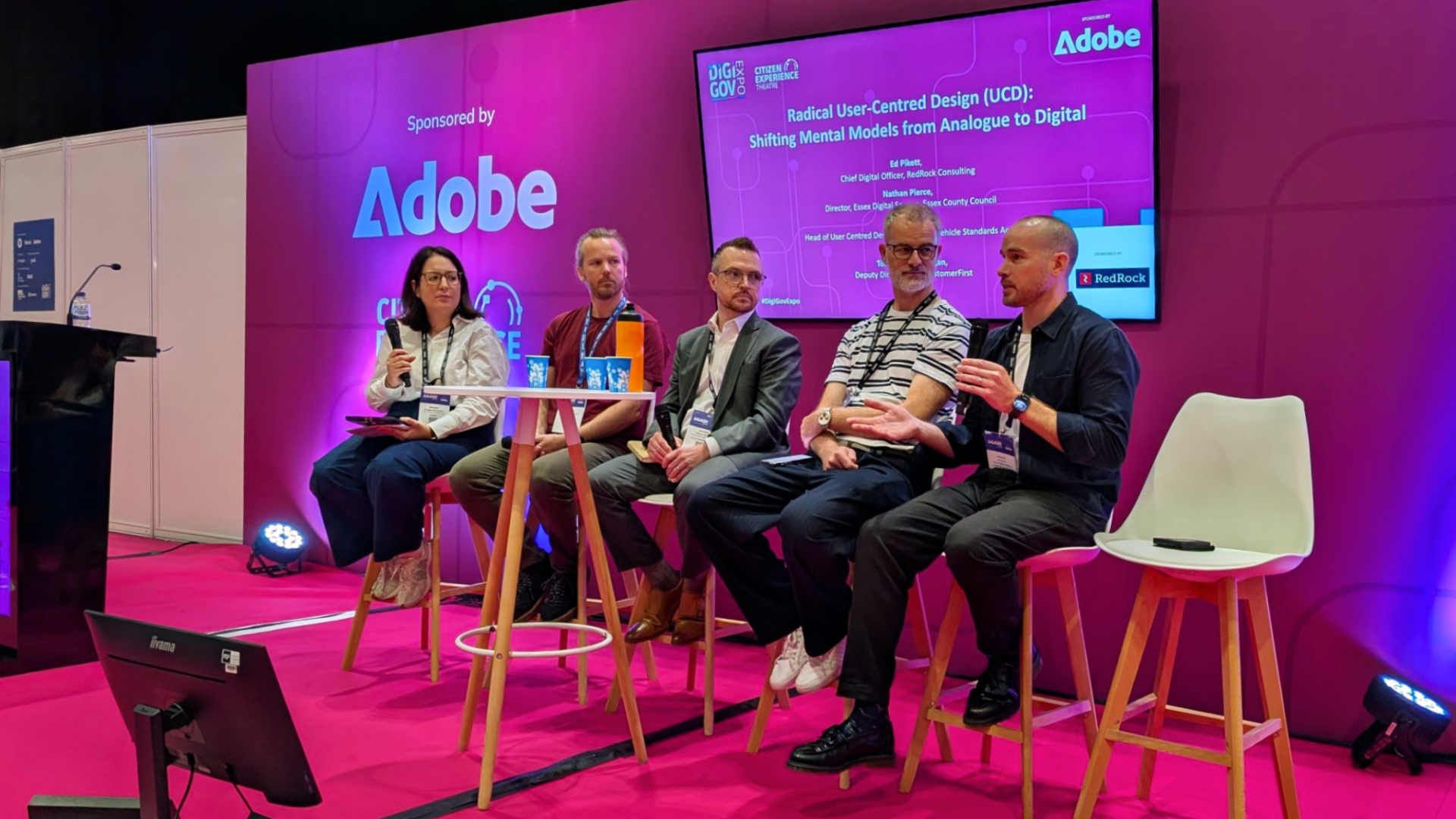
Our Chief Digital Officer, Ed Pikett, recently spoke on a user-centred design panel at DigiGov 2026.
The system is being repeatedly designed around the system it is, not the system it needs to be. User-centred design should run throughout digital transformation, starting at earliest inception, helping to compress the gap between policy operations and technical capabilities.
– Ed Pikett
Ed was joined by Nathan Pierce from Essex County Council, Paul Moran from DVSA and Tom Wynne-Morgan from GDS CustomerFirst.
Thoughts from the panel
The problems below the surface
- AI will not work as a bolt-on
Government cannot continue updating the technology but working within the existing organisational structure. - Organisations snap back
Building service models that work around user needs is easy. Building models that stick and are culturally embedded in government is hard. People easily snap back to old ways of working without embedding cultural shifts. - Organisational division
Breaking down the barriers between strategy, policy and delivery.
-
The answer: a radical redesign, shifting organisational mindsets, and always starting with the outcome for the user.
We need to stop talking about risks based on rates and efficiency and start talking about risks of not achieving outcomes. Government must ensure all services are built end-to-end around people rather than around policy. By understanding the user outcomes, bringing policy, operations and digital teams together, and empowering staff to reconstruct organisational structures, local and central government can begin to solve key user issues.
Users and staff must be at the forefront of change
Users do impact the design of services, but Government has become very good at surfacing needs, and definitely improved understanding performance, although is let down by structures and avoidance of difficult conversations with ministers. Policy is set before teams are engaged to design systems, so UCD cannot be brought in from the very beginning. Localisation and regional devolution of government services gave us an opportunity to have a golden thread of services designed and built by common teams, co-creating from the start, but this still hasn’t hit the mark.
The speed of service delivery is also an issue. Government struggles with problem admiration: cycles of discovery where manifesto commitments don’t align to the findings of research and slow down delivery. We must, however, remember that rapid delivery of the wrong thing is still failure.
Putting people at the centre of the solution, rather than a central policy, could have a positive impact on citizen outcomes across the board.
Mindset shifts, barriers and buy-in
The time for change is now. Local Government Reorganisation is emerging as a catalyst for reinventing operating models, with leaders needing to focus on how to redesign structures, teams and services around user journeys. The opportunity is to build on this momentum, to shift people’s mindsets and make it stick. The solution to this is reducing friction. Friction can be great, it can strike debate and welcome challenges, but unintentional friction due to poor service design is debilitating.
Bureaucracy has always been a barrier. There is a reason why government works best in a crisis, it’s because it operates as a NewCo. Using this approach, there is an opportunity to redesign end-to-end journeys around people rather than institutional boundaries. Through creating safe spaces to design, test and build away from normal government constraints, UCD and digital teams can rapidly create outcome-focused solutions that showcase the incredible opportunities we have to improve user experience across all government services.
Buy-in from all staff, especially leaders, is extremely important when redesigning operational models. To get them to understand the significance of focusing on user outcomes first, having leaders understand the frontline and the experience of the user is key, exposing them to user problems.
The conclusion
Radical user-centred design is actually radical organisational change.
Government broadly knows how to do user-centred design. The radical step is putting it at the centre of the operating model, starting with the outcomes, with senior leaders who hold the line so the organisation does not snap back. Government organisations should start with the structures behind the service. For every policy and every service, ask one question: what does this mean for your users?
RedRock’s model focuses on designing for the user and starting with the outcome. When you are procuring UCD services, our key tip is to focus on the outcome you want to achieve rather than the technology you want to implement.
Find out more about RedRock’s user-centred design services and how we can help you shift your organisation’s focus to user outcomes in the world of modern technology.


Explore associated information
-
Capability
User-Centred Design & Research
-

-
Ready to talk?
See how we can deliver the positive change you need. Talk to one of the team today.